
Automatic Feeding and Fastening Case of a 10 mm Screw Automatic Tightening Machine
Automatic screw feeding case for a 10 mm screw tightening machine. Automation tools have become part of production, shifting from heavy reliance on manual labor in the past to a model where humans and machines work together, reducing workers’ workload while ensuring continuous production. Today’s video shows a case of a 10 mm screw automatic tightening machine with an automatic locking system, allowing you to understand its production process and efficiency.
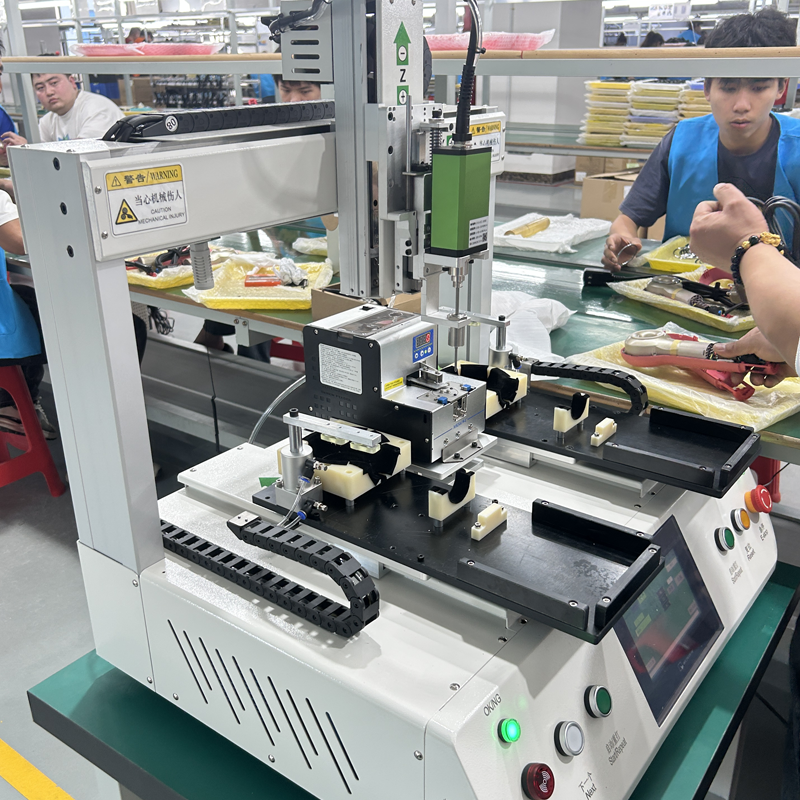
10 mm screws refer to screws with a length of 10 millimeters, commonly used in hardware tools, 3C products, household appliances, and other applications. Automatic screw tightening machines are not limited to a specific screw type or industry; as long as a product requires screw fastening, automated platforms can replace part of the manual labor, making production arrangements more efficient and reasonable.
Difference Between Manual Locking and Machine Locking
The traditional screw fastening method relies on manual work plus manually picking screws. This process takes a relatively long time—on average, it takes about 4–5 seconds to complete one screw fastening. In an 8-hour shift, this equals about 5,760 screws. With an automatic screw tightening machine, the average fastening time is about 1.2–2.5 seconds, allowing up to 11,520 screws to be fastened in 8 hours. This effectively doubles the efficiency. Since the machine is not very expensive, isn’t it very suitable for mass production?
Unstable Quality
Manual operation cannot accurately control the torque value of an electric screwdriver, especially for plastic parts, where it is easy to cause stripped threads. Defective products may even pass into the next process, leading to unstable product quality. In contrast, an automatic screw tightening machine can precisely control the torque of the electric screwdriver and also includes thread-stripping detection, ensuring that every screw is properly fastened in place.
Employees who operate the same product for long periods are prone to fatigue. With the assistance of an automatic screw tightening machine, the screw fastening workload is reduced, and employees only need to place and take the products to complete the entire process requirement. Over the course of the day, there is no need for excessive concentration, while product quality remains stable. Technological progress has made it so that employees are no longer burdened with purely manual and tedious operations; in many cases, machines have already become valuable helpers in production.
Automatic Screw Tightening Machine Usage Steps and Fastening Effect Demonstration
During communication, once we know the screw specifications, product images, and production requirements, we can determine which type of automatic screw tightening machine is suitable for daily production needs. Based on these requirements, the machine platform and screw feeder can be configured accordingly. However, when making fixtures (jigs), a 3D product drawing needs to be provided to us.
Machine Operation Process
Place the automatic screw tightening machine near the production line, connect the power and air supply, then turn on the machine. After the system starts, since no program has been saved yet, you need to set the screw fastening positions for the product and save them into the system. Of course, we also provide video tutorials to help you set the screw points easily.
In terms of machine selection, it is recommended to use a dual-station suction-type screw tightening platform with a servo electric screwdriver. This setup offers higher precision in torque control and performs better when assembling precision parts or 3C products. It is less prone to failures, has very low wear on components, and its failure rate is lower compared to other types of platforms.
Can It Meet Different Screw Fastening Requirements?
In fact, automatic screw tightening machines can be used not only for 10 mm screws but also for screws ranging from 2–35 mm. As long as the screw type is available on the market, it is generally compatible. However, the key challenge is matching the correct screw type with the appropriate machine, which requires you to provide product and screw images for evaluation. You can contact us through our website.
If “10 mm screw” refers to diameter, then it is more difficult. If it refers to length, it is relatively easier. The author will continue to document various case studies to see whether they meet your requirements, comparing screw usage across different industries, and providing both handheld screw machines and automatic screw locking machine case examples.